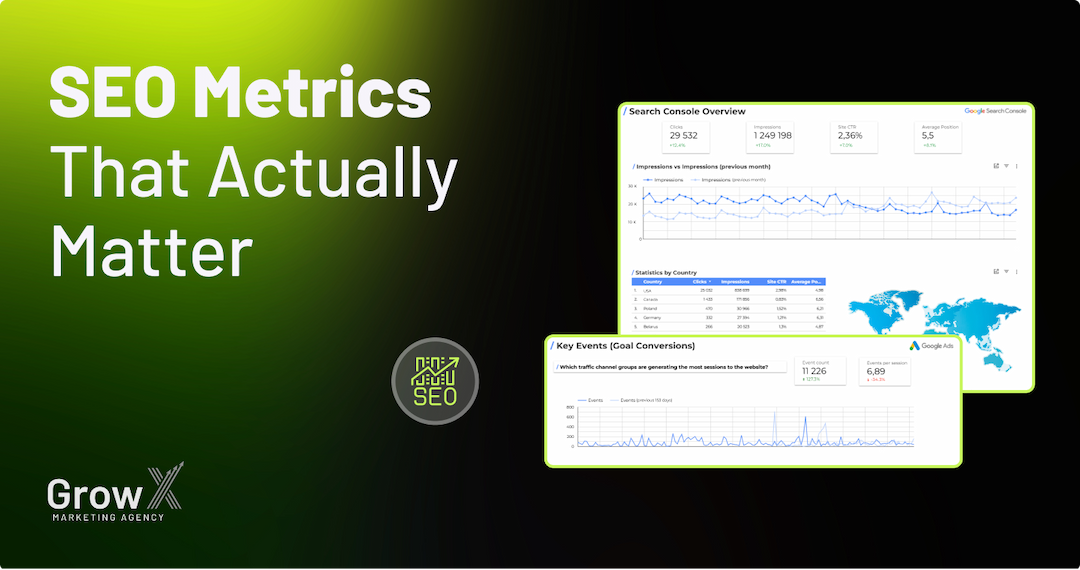
SEO Metrics That Actually Matter (and What Most Reports Completely Miss)
Most SEO reports look impressive but don’t help leaders make decisions. They list rankings, sessions and charts without explaining what actually drives revenue.

Duplicate content is a common issue for ecommerce websites. If the content of several pages is similar or identical, search engines may find it challenging to determine which page to index. This results in a fluctuating ranking and lowered visibility.
Effective search engine optimization requires knowledge of duplicate content. The performance of websites can be negatively impacted by not conducting frequent searches for duplicate content. The aim is to prevent duplicate content and guide search engines to select the appropriate version of each page.
What can be deduced from this article:
Duplicate content in ecommerce is not limited to repeated text, but also encompasses the multiple versions of the same content that are present on your site. Search engine optimization requires knowledge about duplicate content, as large ecommerce websites often generate redundant pages automatically. If there is no control, search engines struggle to index a page correctly and prioritize the right version.
Check out our SEO experts blog for more information.
Unoriginal content refers to pages that are identical or very similar on your site. This is frequently the case when product descriptions are repeated or when multiple pages are devoted to the same keywords. Even text that has been slightly altered but retains its core value can be considered SEO duplicate.
The presence of multiple duplicate pages in ecommerce is frequently caused by the use of different URLs, rather than just repeated text.
Multiple URLs can contain the same product due to different filters, categories or variations. Although the content is similar, these are treated as separate pages by search engines.
Search engines merge multiple copies of a webpage and endeavor to identify the most preferred version. They will pick you if you don't know what it is. The indexing of the wrong page can result in rankings and traffic being negatively impacted by this.
It is common for ecommerce websites to contain copyrighted content. It arises from the way platforms design pages, filters and product variations. Without proper control these technical elements create several competing duplicate pages. Many brands rely on ecommerce SEO services to identify and quickly resolve issues.
Different versions of a product, such as size or color, frequently generate distinct URLs. Canonical tags and redirects are not used by search engines to recognize each version as a separate page.
This results in duplicate content and splits ranking signals between pages. Your webpage is not a single strong page. Rather, it has several weak ones competing for identical keywords.
The use of filters, sorting options and URL parameters can result in a significant increase in the number of pages on your site.
Different URLs may contain a similar list of products, determined by their price, popularity or attributes. Search engines regard these versions as distinct, even if the content is not significantly different. The production of homogeneous content on a large scale can pose an SEO risk of duplicate content in your ecommerce store.

Duplicate pages are a significant issue due to their pagination and category structure.
If the products are presented in multiple category pages or even on paginated lists, search engines may find it challenging to determine which version is preferred. This becomes more intricate with faceted navigation, which generates dozens or even hundreds of unique URL combinations.
If left unmanaged, crawl efficiency is compromised, duplication of content occurs and search engines find it more difficult to prioritize the most relevant pages.
This duplicated content problem goes beyond technical. It affects search results on your ecommerce site. Search engines find it challenging to prioritize the right URLs when they come across too many duplicate pages or content that is similar. Rankings become unstable, crawling is not efficient and visibility opportunities are often lost.
The competition between pages specializing in the same keywords is evident. The act of cannibalizing is commonly referred to as keyword usage. This creates confusion for search engines and weakens the stability of their rankings.
Duplicate content has an impact on both crawl efficiency and ranking. Search engines spend more time crawling duplicate pages than examining vital ones. Consequently, high-value pages may not be properly indexed.

It can be fixed first by identifying duplicate content. There are numerous instances of ecommerce website duplication that are not immediately apparent. These problems are only catching up and affecting performance when properly examined. A systematic approach can be used to identify duplicate content and take charge of it before it impacts rankings and indexing.
You can conduct a comprehensive technical audit to ensure that duplicate content is present on all pages of your ecommerce website. This approach is not limited to mere observation and concentrates on the structure of your site.
It is necessary to scrutinize URL variants, metadata, titles and internal linking conventions. Identifying different versions of the same page, whether through filters, categories or parameters is crucial.
An accurate assessment identifies instances of duplicate pages, their association and the recommended version. All are considered valid. This provides a clear path to help you remove duplicate content and improve your search engine rankings.

You can always seek the assistance of a digital marketing expert near for specialized guidance.
Find several URLs that lead to the same or similar content. To avoid duplication, it is recommended to review title tags, descriptions and H1 headings. Ecommerce SEO services can assist with the removal of duplicate content and structural issues while ensuring efficient optimization.
Long-term SEO success is dependent on understanding how search engines handle duplicate content. Not every duplication gets penalized by Google - but they do try to find the most relevant version of a page.
When you have unclear signals, Google may index your website as wrong, causing it to be less visible and organic traffic depleted.
Google sorts similar pages and chooses a particular one to index and rank. Links, content consistency, URL structure and authority are among the internal signals that are necessary for this process.
In case of inconsistent signals, Google may choose to index a less important version or distribute ranking signals across multiple pages. This frequently results in unsteady outcomes and reduced visibility in search results.
These actions aid in the identification of your site.
Both strategic and technical challenges arise in ecommerce due to the problem of duplicate content. Large stores with hundreds of products can quickly create duplicates. When there is no control, rankings and conversions drop.
Enhanced SEO rules, structured content, regular audits and clear policies are all components of a scalable system. Our online marketing portfolio contains authentic instances.


To begin with, identify duplicate pages and then utilize canonical tags, redirects and improved content to harmonize signals.
A common solution is to use canonical tags, which specify the preferred version of a page.
Ecommerce, some duplication is normal. The main focus is on managing it to avoid confusion with search engines or affecting indexing.